This article has been developed and refined by the Finextra team, focusing on its relevance and appeal to our readership.
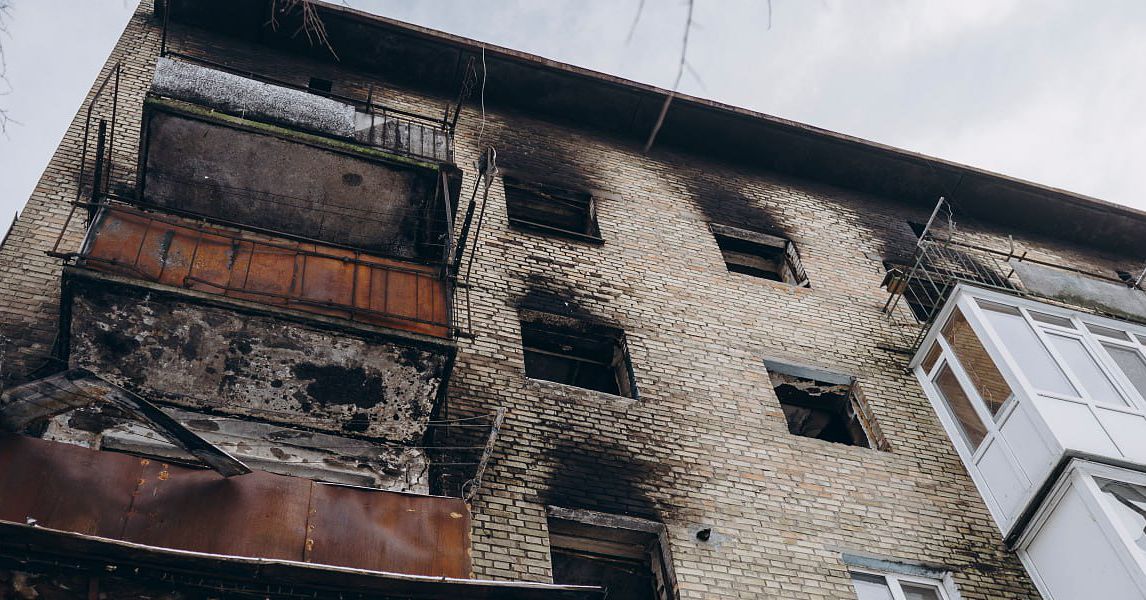
In Borodianka, a concrete apartment building has been severely damaged by airstrikes and mortar fire. Some residents endured the harsh winter within its walls, having mended a hole themselves.
Similarly, in Hostomel, a large residential complex suffered damage from a missile launched by Russian forces before being taken over by soldiers. According to reports from Kyiv, the area was mined by the invaders prior to their departure. Alyona, a former occupant, expressed her determination to return: “This was the home where we shared beautiful moments together with our family,” she stated in a message shared by United24.
As Ukraine continues to seek support, a new fundraising initiative has emerged amid what the country’s finance minister described as a sense of donor “fatigue.” Yaroslava Gres, the primary coordinator for United24, aims to reignite donor enthusiasm. He poses the question: “What will inspire them to keep supporting Ukraine?”
Gres hopes that demonstrating the homes needing reconstruction and sharing stories from those eager to return will encourage ongoing contributions. “Storytelling allows our supporters to connect with the individuals they are assisting, as well as the specific projects they are funding,” he noted.
The project’s 3D models were created in collaboration with LUN, a Ukrainian real estate platform. The company sent photographers equipped with drones to capture images of damaged structures across the nation, which were later transformed into digital replicas. Architects subsequently used these representations to strategize the rebuilding process.
“We have focused on digitizing urban development for years, envisioning the growth of cities and new constructions,” a representative from LUN remarked. “Witnessing the destruction was challenging; it required reviewing countless images to accurately portray the damage.”
These 3D models will also feature augmented reality technology, allowing users to visualize the buildings using smartphones or AR headsets.
The task of restoring Ukraine’s civil infrastructure is anticipated to be both extensive and complex. In a presentation delivered in May, Maksym Smilianets, co-owner of a Ukrainian internet service provider, illustrated the scale of the obstacles faced in reconnecting the nation. He noted that airstrikes had severely impacted the telecommunication systems, prompting the laying of hundreds of kilometers of fiber-optic cables to restore connectivity.
In areas still under Russian control, the occupiers swiftly transitioned the internet services to a Moscow-controlled system, stealing local equipment in the process. Smilianets explained that repair teams in reclaimed zones encountered traps within the telecommunications infrastructure meant to hinder repairs. “They took every possible measure to achieve total disconnection,” he stated.
As companies like Viner work toward reconstructing Ukraine’s once-thriving communication network, substantial efforts will be needed to reconnect countless damaged homes and apartment buildings across the country. The final connections could demand hundreds of additional kilometers of fiber-optic cabling.
Ukrainian President Volodymyr Zelensky emphasized during the Ukraine Recovery Conference in London last June, “While we cannot eradicate the darker aspects of human nature that lead to destruction, we have the power to safeguard life and rise from the ruins.”