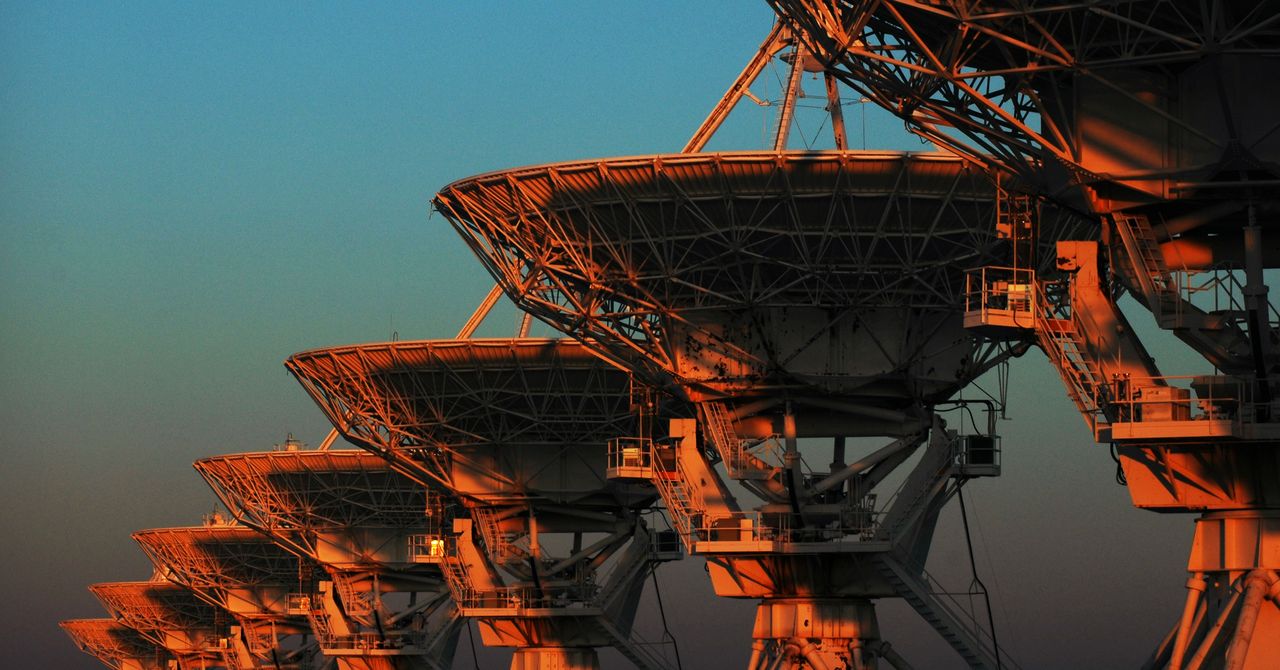
Most recently, the NRAO played a significant role in establishing the Atacama Large Millimeter/Submillimeter Array (ALMA) in Chile. The project exceeded a billion-dollar budget, with around $500 million contributed by the NSF and approximately $40 million needed annually for its operation. Its impact is notable; in the field of US astronomy, interferometers—telescopes like ALMA composed of numerous smaller antennas—are currently favored over large single-dish telescopes, as pointed out by NSF astronomy division director Richard Green. “We really try to be responsive to community interest,” he states. Interferometers deliver superior resolution, producing clearer images of smaller areas while enabling the exploration of many of the same celestial phenomena.
While large single-dish telescopes still attract interest—especially for mapping extensive gaseous regions of the sky, monitoring pulsars, and detecting faint emissions that interferometers may overlook—they have faced budget cuts, leading to the closure of facilities like Arecibo and Green Bank.
As the NSF gradually reduces funding for Green Bank and Arecibo, these observatories are seeking support through alternative means, primarily through commercial partnerships. A SETI initiative and collaboration among pulsar researchers focused on gravitational waves are essential for keeping Green Bank operational. International partnerships, including funding from Russia for their scientific missions and financial contributions from the Navy for monitoring Earth’s tilt, are also vital.
This approach introduces a new financial model that the agency can leverage to sustain older telescopes. Currently, the NSF still provides part of the funding for their operational hours, allowing open access for innovative proposals, while the rest of the time is dictated by the priorities of paying clients. “We are able to keep the facilities running,” remarks Joseph Pesce, NSF’s program director for the NRAO, which separated Green Bank and the VLBA from the main observatory in 2016. “That’s a good solution to this problem.”
Moreover, this model could create opportunities for developing additional resources that astronomers are interested in, such as new array-based telescopes.
A potential new facility on the horizon is the Next-Generation VLA (ngVLA). While the existing VLA has been operational for 40 years, the ngVLA is envisioned to feature multiple antennas that collectively will have ten times the sensitivity and resolution compared to the VLA, covering a broader spectrum of frequencies. The main array will consist of 214 18-meter antennas spread across New Mexico, Texas, Arizona, and Mexico, with 19 smaller antennas positioned centrally and an additional 30 antennas distributed across the continent.
The project scientist for the ngVLA, Eric Murphy, envisions that this advanced instrument could enable astronomers to produce high-definition sequences of solar system formations—an endeavor previously hindered by the obscuring dust around nascent planets and insufficiently sharp radio images. It may also allow for the capture of collisions leading to gravitational-wave events, even at distances of up to 650 million light-years, and facilitate the discovery of more molecules that predate the emergence of life in developing star systems.
However, the realization of this ambitious project hinges on a committee’s assessment of its importance during the 2020 Decadal Survey—a strategic evaluation conducted every decade by astronomers. If it earns a favorable ranking and secures adequate funding, construction could commence around 2025.