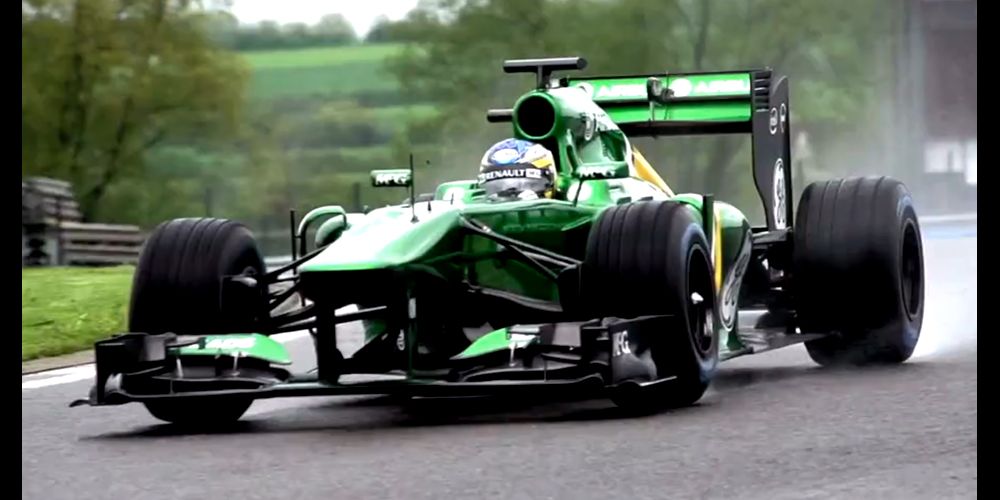
Competing in Formula One is infamously costly even for the less successful teams, and this season has seen not just one, but two teams face bankruptcy. One of these teams, Caterham, has already missed two races and is turning to its fanbase for assistance in reaching the season finale in Abu Dhabi. To achieve this, Caterham is embarking on a familiar route taken by entrepreneurs and philanthropists alike: it has launched a crowdfunding campaign aimed at raising £2.35 million ($3.72 million).
You might chuckle at this, but just four days after its launch on Crowdcube, a UK-based crowdfunding platform, the campaign has already amassed over £1.1 million, which is 47 percent of its target with a deadline set for November 14. “That’s a promising start,” remarks Finbarr O’Connell, Caterham’s interim principal and administrator, akin to a Chapter 11 trustee in the UK.
O’Connell faces the hefty challenge of doing whatever it takes to save the F1 team and the livelihoods of numerous staff members—none of whom received payment in October. If the team doesn’t find a buyer soon, those individuals may have to search for other opportunities. Enticing investors is a hard task when the cars are sidelined and unable to compete.
Potential investors need to have substantial financial backing. Operating a team could cost between $110 million and $130 million annually, and successful teams might spend even more. For large corporations like Mercedes-Benz and Red Bull, that expense aligns comfortably with marketing and motorsport budgets. However, independent teams like Caterham, which rely on individual owners, require a meticulous approach to securing sponsorship deals to cover operational costs.
The financial dynamics of the sport render survival precarious for all but the richest teams, creating a challenging cycle; prize money is distributed based on performance, so success breeds financial reward. This season, Caterham has not finished higher than 11th in any race, leaving it at the bottom of the standings with zero points. In contrast, Mercedes boasts over 600 points and has already clinched the constructor’s championship with three races remaining, as its drivers, Lewis Hamilton and Nico Rosberg, lead the charge for the driver’s crown. “As wealthier teams advance with improved vehicles, it pressures other teams to keep up,” O’Connell explains. “That generates financial strain.”
Gaining Visibility
Securing funds is merely a short-term measure. “This is a project aimed at just one race, intended to showcase the team,” O’Connell notes. To secure a future for Caterham, a new owner needs to be found, and demonstrating that the team can still compete is crucial to attract potential buyers. There are interested suitors, including a wealthy family from the Middle East, but they are hesitant to invest in a struggling venture, according to O’Connell. Caterham has resolved the issues with its vehicle, and making it to the grid in Abu Dhabi “will demonstrate its full potential.”
The Crowdcube campaign can also rally the fanbase, allowing supporters to engage in a sport where expenses exceed the means of most millionaires. It presents an opportunity for fans to obtain unique memorabilia. Contributors can receive standard F1 merchandise such as caps, t-shirts, and polo shirts, but also exclusive items like pit crew uniforms, boots, and gloves.
For higher contributions, fans can acquire pieces of Caterham’s 2012 and 2013 race cars: £2,200 for an aerodynamic component called a turning vane, £5,500 for a nose cone, or £3,000 for a rear wing. The front wing from the 2013 car has already been purchased for £2,500, though Caterham remains tight-lipped about the purchaser. More affordable options include four available bargeboards from the 2012 vehicle at £400, which is less than the cost of the overalls. For £1,000, contributors can have their name painted on the car, in print large enough to be visible on television.
However, crowdfunding carries inherent risks; it’s an all-or-nothing endeavor. If Caterham fails to reach the ambitious £2.35 million goal, it will receive no funds, and contributors won’t receive their rewards. Yet, if successful, the team could find a way to persist and at least compete in one more race. “Everyone who contributes will look at the team on the grid in Abu Dhabi and say, ‘That’s my team,’” O’Connell concludes.